Spring Loaded Art
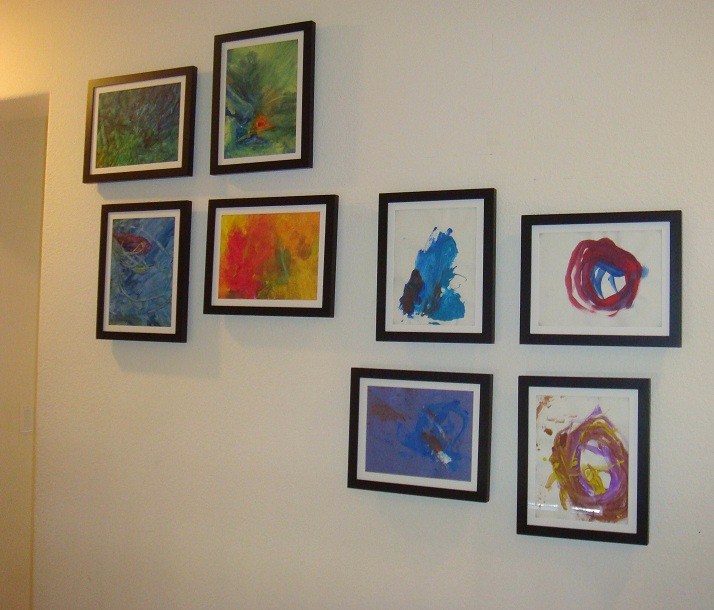
Lil Davinci Frames art wall
As our newest exhibit opens we see the works of artists A and Z side by side. Notice the intensive celebration of color that characterizes Z’s work (left),while A’s work (right) shares with us an exploratory journey ranging from modern portraiture (Cookie Monster) to abstract minimalism.
I told you I’d write a post about those Lil Davinci Frames, right? (aka: Pez Art Dispensers )
I live in Northern California and the company that makes the frames is located in Southern California (near where I grew up, actually). I think the ship time averaged 2 days from order to receiving. Here’s how the big package (8 units) arrived:
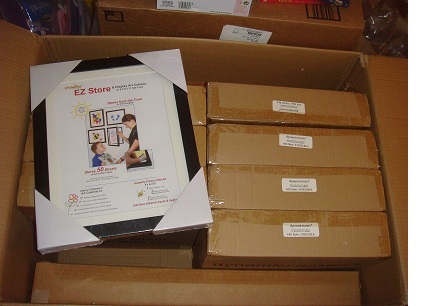
Lil Davinci shipment, with one unpacked
Pretty well packed. The second shipment of 4 units came with the smaller individual boxes taped together, which was fine since each individual frame box is really well padded inside.
As I said in my previous post about my kids’ art, these frames are made like little cabinets that you can open while it remains mounted on the wall. You can insert art by pressing down the spring loaded backing and slipping the edges under the corner holders. The springs press the art against the glass frames so there’s no wierd gap in the effect. You can load a bunch of artwork (sized to frame or else they bunch up or fall out) on top of the older pieces so it also acts like a storage cabinet. Pretty neat, huh?
Quick Notes about a Real Installation
- They give you a guide paper to tape to the wall to help with layout and making holes in your wall. Note that the guides are smaller than the actual frames and give yourself space, accordingly. Also, if you ever plan on moving the frames, you might want to keep all the guides, even with the holes in them.
- The guide notes two types of installation and I used the more secure option. I don’t think I want these falling on me when I’m standing on tiptoes trying to shove in some paper.
- I put my art in before I installed them on the wall. This let me adjust the paper more (I had to cut them down again sometimes) and neatly reinsert any stack of art I wanted to store from the beginning without stressing the installation. Try to remember where the hinge side is in relation to your art orientation. I planned to have the hinge be on the top of horizontal installations and on the left of vertical ones.
- They give you some plastic anchors in case you’re installing into drywall. I drilled the hole to the size given but I still broke two of the anchors when poking them in. I recommend picking up some self-drilling plastic anchors when you’re at the hardware store one day. They’re good for so many drywall installations: art, shelves, whatever.
- It’s a bit hard to do the more secure installation, which screws through the frame into the wall because you have to hold the frame open while doing so. This gives a cleaner finish, as you can’t see the screws when you’re done, but you need some Jenga patience to hold the cabinet open on the wall, line up the holes to the back, and screw it in. I ended up propping the door open with the top of my head for the horizontal installations.
- The glass in the cabinet face is held in by stiff metal tabs. I was a little worried about them when I had to hold the cabinet open to install them. I tried not to hold the cabinet only by this face as I think they could pop out if pressured too much. Otherwise, they’re sturdy enough for normal use.
- Since I did the installation all by myself, I did not take pictures of myself on the step ladder, as this would involve even more arms than I already did not have.
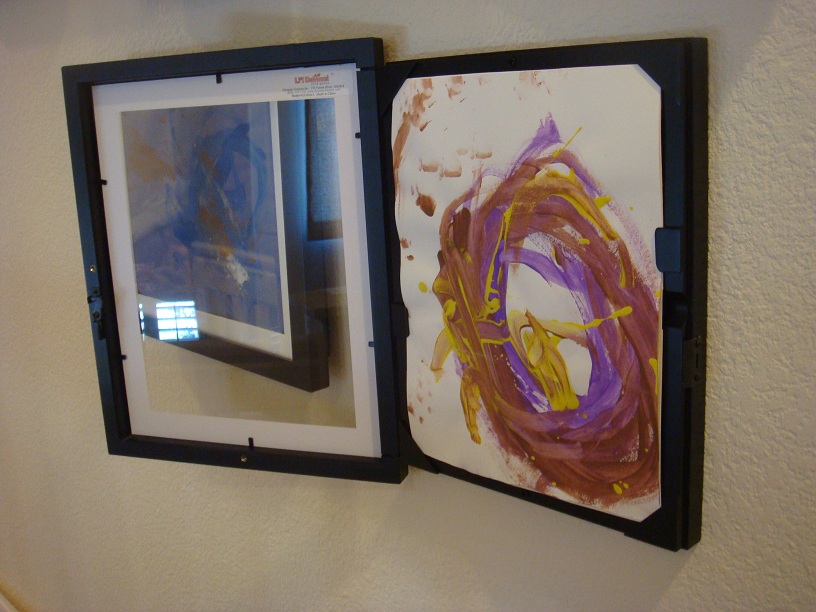
Open Frame Cabinet
There! All nice and neat.
Notes about Sticking in the Art
- Your papers really should be as close to uniform in size as you can get and match the size of the frame you have. I had to cut down some art and every piece that was a little too long ended up wrinkling or pushing out the other pieces.
- Flatten wrinkly pieces as much as possible before inserting. Again, this makes the stacking of papers much easier.
- Maybe if you have perfectly flat pieces of art you can get about 50 sheets in (as advertised). I think I stopped at much less than that. Maybe 25 or 30 because the painted pieces of paper have a lot more thickness and warp to them so the springs start getting unhappy if I went higher.
- It feels like there’s springs at each corner that act independently, so the pressure is different across the paper. If your artwork is wrinkly and uneven (as my paintings are) you will get a little corner squishing (stays that way when you take the paper out), so if you’re paranoid about keeping any of these pieces pristine, then you should probably use a normal art frame.
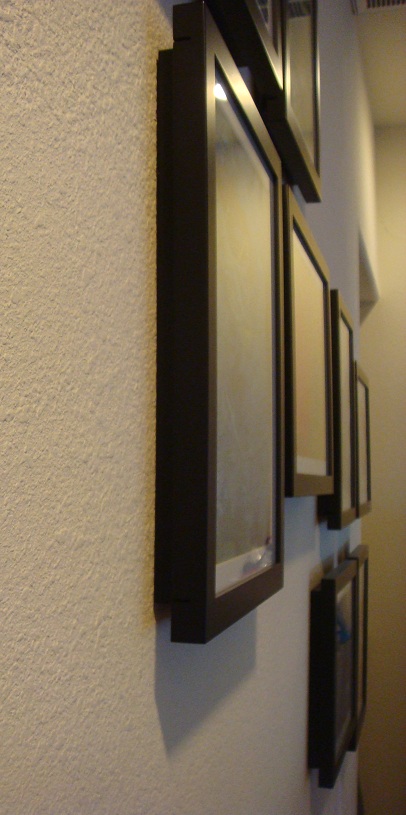
Side View
Final Notes about the Product
- The entire cabinet frame seems pretty sturdy and well made. Out of eight frames only one latch did not slip closed by itself and was a little trickier to work.
- I liked the depth of the cabinets. They weren’t so deep that they looked stupid from the side.
- Don’t lose the screws! They’re stuck inside the plastic wrapping, near one of the cardboard corners, but they also slide around. I almost threw some away before I looked in the right spot.
- There’s good reviews of this product at Amazon, especially in comparison to similar products by other manufacturers. I bought these directly from the manufacturer, though, because there was a package deal.
- The product also comes with some sort of prop leg so you can stand it on a table, but I have no interest in this feature, so I can’t tell you how well that works.
I really like these things. The same company that makes these makes other types of cabinet boxes for display too. All in all, pretty nifty ideas! I’m probably going to end up trying some of their other products before the kids get too much older. Because.. you know.. I like to buy things.
** No one is paying me for mentioning their product or for saying nice things.**
*** If someone wants to send me more frames, though, I could use some more 9″x12″s in black because I was stupid and assumed construction paper was 8.5″x11″. It is not.***
**** All art shown are my children’s original artwork with all rights reserved, etc. ****